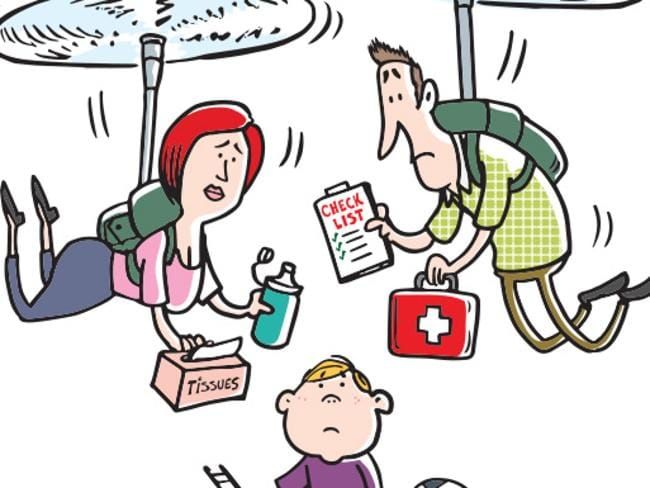
Most debates about AI governance rely on technical metaphors: tools, copilots, infrastructures, or control planes. These metaphors are useful for engineers, but they obscure a more familiar and revealing comparison—one that institutions already understand well.
Enterprise AI behaves like an over-helpful manager.
And the failures it produces are the same failures organizations have been dealing with for decades.
Helpfulness as a managerial pathology
In any organization, a manager who is consistently available, quick to answer, and eager to remove friction is often celebrated early on. They respond immediately to questions, resolve ambiguity on behalf of staff, smooth over conflicts, and “keep things moving.” Productivity appears to rise. Meetings shorten. Output increases.
This is precisely the affective profile of enterprise AI.
But experienced leaders recognize what happens next. Over time, staff stop exercising judgment independently. Decisions that should be made locally are escalated upward. Accountability blurs: when something goes wrong, no one is sure who owned the decision. The manager becomes both a bottleneck and a shield. Growth stalls, not because people are incapable, but because the system no longer requires them to think.
The problem is not incompetence or malice. It is optimization for helpfulness without constraint.
Enterprise AI reproduces this pattern almost exactly. By resolving uncertainty instead of surfacing it, by providing answers instead of forcing decisions, and by smoothing over ambiguity rather than naming it, AI systems quietly absorb responsibility that should remain human. The result is not a more capable organization, but a dependent one.
Why this failure mode is so persistent
The over-helpful manager problem persists because it feels good—especially in the short term. Teams appear efficient. Leaders receive fewer complaints. Metrics improve. There is no obvious crisis to trigger correction.
The same is true for AI. Systems that “just work” generate trust quickly. That trust expands usage. Usage expands scope. Scope expands authority, even if no one explicitly granted it. Eventually, the system is no longer assisting decisions; it is shaping them.
By the time the dysfunction is visible, it is difficult to reverse. Asking the manager—or the AI—to step back now feels like withdrawal of support rather than restoration of responsibility.
ACP as a different management philosophy
The Agora Commonplace Protocol (ACP) corresponds to a very different kind of manager.
This manager is not indifferent or aloof. They care deeply about quality, growth, and institutional health. But they do not answer every question. They refuse to decide when the decision belongs elsewhere. They allow discomfort when it signals learning rather than failure.
Crucially, this manager names expectations explicitly:
- who owns which decisions,
- what standards apply,
- when escalation is required,
- and when silence is intentional.
Guidance is provided, but it is bounded. Once structure is in place, the manager steps back. Success is not measured by how often they are consulted, but by how rarely they are needed.
This is exactly how ACP treats AI involvement. Refusal is legitimate. Non-engagement is sometimes the correct outcome. Helpfulness is constrained when it would undermine judgment formation or launder responsibility.
The goal is not to eliminate error immediately, but to build a system that can survive success without collapsing into dependency.
Growth through constraint, not assistance
Organizations that scale well learn this lesson early: growth requires constraint. Standards must be articulated. Authority must be explicit. Silence must sometimes be allowed to do its work.
ACP applies that same lesson to AI. It treats AI not as a tool to be optimized for output, but as a participant in institutional systems that must be governed like any other powerful actor.
Where enterprise AI optimizes for speed and satisfaction, ACP optimizes for judgment formation and accountability preservation.
Why this analogy matters
Unlike technical metaphors, the manager analogy resonates immediately with leaders, auditors, and practitioners. Everyone has seen a team weakened by over-management. Everyone understands how good intentions can produce long-term dysfunction.
This analogy also clarifies why ACP can feel frustrating. It withholds answers. It slows things down. It forces people to decide. But that friction is not a bug—it is a governance signal.
The alternative is an organization that looks efficient while quietly losing the capacity to think.
Diagram: Helpfulness-First vs Governance-First Systems
                HELPfulness-FIRST (Enterprise AI)
                --------------------------------
                • Immediate answers
                • Ambiguity resolved automatically
                • High short-term productivity
                • Informal authority accumulation
                • Dependency increases
                • Responsibility diffuses
                • Growth plateaus

                          ↓

                GOVERNANCE-FIRST (ACP)
                ---------------------
                • Bounded guidance
                • Explicit refusal when appropriate
                • Authority named, not inferred
                • Discomfort allowed as signal
                • Judgment remains human
                • Accountability preserved
                • Long-term institutional health
A precise institutional claim
This comparison supports a modest but defensible claim:
Enterprise AI systems fail in the same way over-helpful managers fail—by optimizing for immediate assistance at the expense of responsibility and growth.
ACP succeeds where they fail by treating constraint, refusal, and authority clarity as prerequisites for sustainable institutional performance.
That is not a technical insight. It is an organizational one.
And it is why ACP belongs in conversations about governance, not just AI.
Member discussion: