The Checkdown Decision
Case Type
Decision-forcing teaching case
(Designed for 45–90 minutes of discussion)
Core Themes
- Ego vs. role discipline
- Variance control
- Decision authority under pressure
- Reliability vs. brilliance
- Governance as architecture
Case Part I: The Moment (Football)
The Situation
Date: October 1, 2023
Game: Kansas City Chiefs vs. New York Jets
Quarter: 4th
Clock: Under 2 minutes
Score: Chiefs leading
The Chiefs have the ball and are attempting to close out the game. A first down effectively ends it.
Quarterback Patrick Mahomes, widely regarded as the most talented player in the league, scrambles out of the pocket. The defense opens a clear path to the end zone.
From the standpoint of:
- fans,
- commentators,
- personal statistics,
- highlight reels,
scoring is the obvious move.
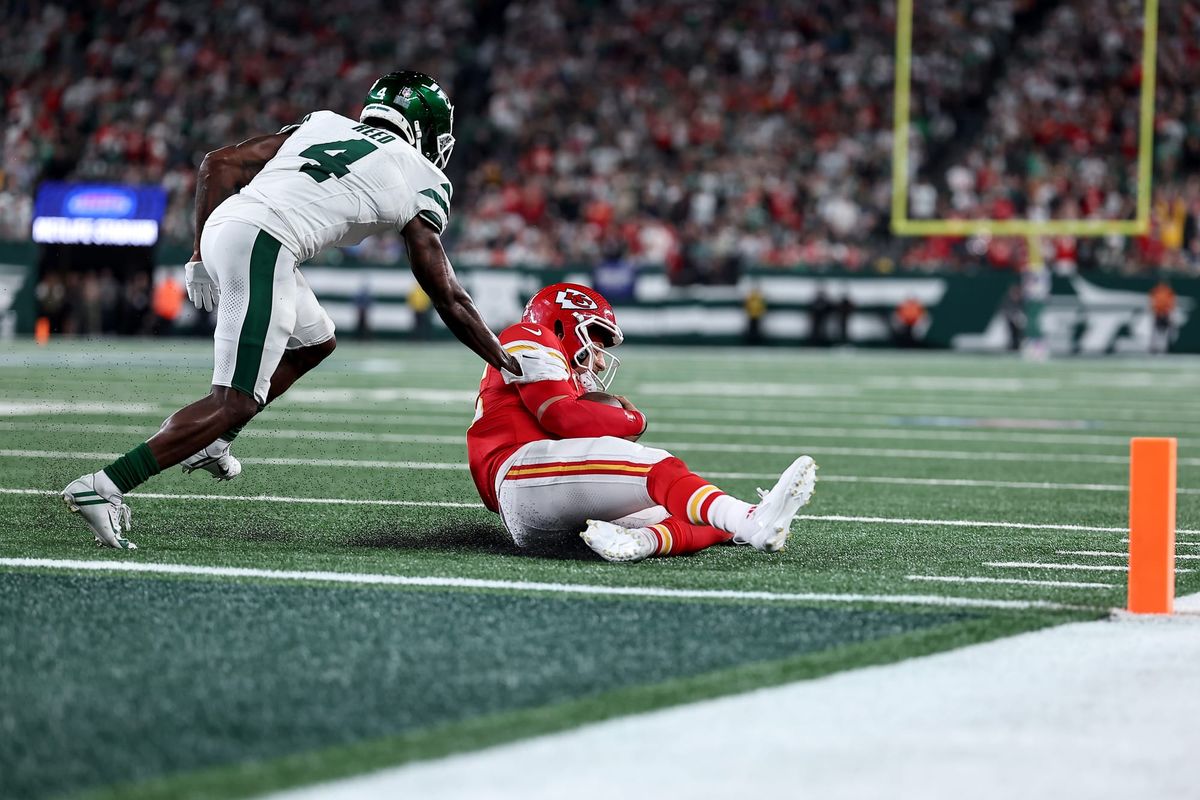
Instead, Mahomes slides short of the goal line, allowing the Chiefs to kneel out the clock and guarantee victory.
The crowd reacts with confusion and applause. Commentators quickly realize what happened.
Immediate Question for Participants
Was this a conservative decision, a smart decision, or an unnecessary sacrifice?
Case Part II: Deconstructing the Decision
Facilitators should press participants to articulate why the decision was correct without appealing to hindsight.
Discussion Prompts
- What risks would a touchdown introduce?
- What risks would it eliminate?
- Who benefits from the slide?
- Who loses from it?
- Would the decision be praised if the team were trailing?
Key Insight (to be surfaced, not told)
The decision reduced variance at the moment when variance was no longer valuable.
Mahomes did not:
- maximize points,
- maximize personal credit,
- maximize spectacle.
He maximized certainty of outcome.
Case Part III: Translating the Moment (Institutional Analogue)
The Parallel Scenario
You are part of a senior leadership team in a public institution (government agency, regulator, or large platform).
A high-capability system or senior official proposes a bold action:
- a rapid rollout,
- a strong public statement,
- a unilateral technical change.
The action is likely to succeed — but if it fails, the downside is severe:
- reputational damage,
- legal exposure,
- loss of trust,
- cascading institutional failure.
There is an alternative:
- slower,
- less visible,
- less impressive,
- but significantly safer.
Decision Prompt
Do you authorize the bold action, or do you “slide short of the goal line”?
Case Part IV: Ego and Incentives
Participants are now asked to confront why this decision is hard.
Structured Questions
- Who gets credit if the bold action succeeds?
- Who bears blame if it fails?
- Is the person advocating the action also insulated from consequences?
- How does visibility affect judgment?
Facilitator Insight
Ego here is not arrogance. It is structural incentive:
- praise is immediate,
- harm is delayed,
- responsibility is diffused.
Institutions systematically reward “touchdowns” more than “kneel-downs.”
Case Part V: When the Same Decision Goes Wrong
Introduce a contrast case.
Counterexample (Brief)
A leader or system:
- forces action late,
- exceeds scope,
- improvises under pressure,
- produces a visible win followed by downstream harm.
Facilitators may let participants supply their own examples:
- rushed policy announcements,
- unvetted deployments,
- unilateral executive decisions,
- AI systems acting beyond remit.
Key Contrast
The failure is rarely due to incompetence.
It is due to failure to switch modes from exploration to protection.
Case Part VI: The Governance Question
Now the core teaching move.
Prompt
Why are we relying on individual judgment at all in moments like this?
Participants should be guided to articulate:
- Why “just trust good people” is insufficient
- Why brilliance does not scale safely
- Why ego cannot be trained away
This is where the football analogy completes its work.
Football teams do not rely on quarterbacks to remember when to slide.
They encode:
- clock rules,
- down-and-distance logic,
- play calling constraints.
Institutions must do the same.
Case Part VII: Introducing the Concept (ACP, Explicitly)
Only now do you name it.
Framing
ACP is introduced as a game-manager architecture:
- It does not eliminate capability.
- It eliminates unbounded authority.
- It treats refusal as a valid outcome.
- It forces decisions back to humans at the boundary.
Mapping Exercise
Ask participants to map elements of the Mahomes decision to governance features:
| Football | Governance |
|---|---|
| Sliding instead of scoring | Refusal / delay |
| Running out the clock | Risk containment |
| Letting defense finish | Oversight & review |
| Avoiding highlight | Anti-hero design |
Case Part VIII: Decision-forcing Close
Final Question
If your institution were one play away from victory, how would you prevent someone from forcing a throw?
Participants should be pushed to propose structural answers, not cultural ones:
- approval gates,
- scope locks,
- read-only defaults,
- audit requirements,
- kill switches.
Teaching Notes (for Facilitator)
What this case teaches
- Ego is predictable, not pathological.
- Reliability beats brilliance in late-stage systems.
- Governance is about designing the kneel-down.
Common failure modes in discussion
- Romanticizing heroics
- Over-indexing on hindsight
- Treating humility as character rather than architecture
What success looks like
Participants leave convinced that:
- the most dangerous moment is when success seems close,
- the best systems plan for restraint,
- and the hardest decision is often the one that looks boring.
Optional Extensions
- Replace football with aviation or finance for different audiences
- Run the case twice: once without naming ACP, once with
- Pair with a real institutional failure post-mortem
Member discussion: