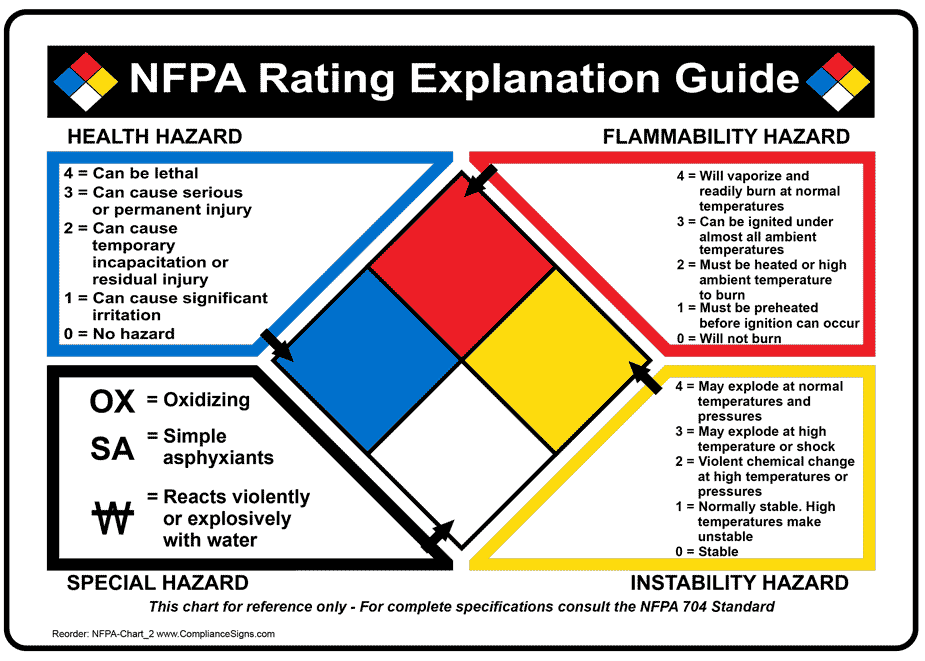
The NFPA Precedent
The NFPA hazard rating system is a standardized visual framework used to communicate how chemicals behave under emergency conditions. Developed by the National Fire Protection Association (NFPA)—a U.S.-based nonprofit founded in 1896—the NFPA 704 “diamond” was introduced in the 1950s to help first responders rapidly interpret risk during fires, spills, and industrial accidents. Each axis isolates a distinct dimension of hazard, preventing different kinds of risk from being conflated under a single warning. The system does not evaluate whether a substance is useful, legal, or well-designed. Its purpose is controlled interpretation under time pressure.
What NFPA demonstrates is that governance can be embedded directly into representation, rather than deferred to policy documents, manuals, or expert judgment alone.
What the NFPA Model Gets Right
NFPA 704 works because it:
- Separates risk into orthogonal dimensions, rather than collapsing it into a single score
- Assumes context of encounter, not intent or product quality
- Signals behavior under stress, not theoretical properties
- Enables rapid interpretation by non-experts without requiring full documentation
The system exists to answer a narrow but urgent question:
If someone encounters this substance in a specific context, what kinds of actions are authorized, constrained, or forbidden?
An AI analogue should serve the same function.
What Is Being Labeled in AI
In AI systems, the hazard is not the model itself but the claims it produces and the way those claims are allowed to function in practice. Across recent incidents, harm arises not because AI systems generate content, but because claims are permitted to stabilize as actionable knowledge without explicit authorization.
Health summaries become medical advice.
Administrative summaries become records.
Encyclopedic outputs become reference knowledge.
In each case, authority emerges through interface design, repetition, and scale—rather than through deliberate institutional approval.
An NFPA-style AI artifact would therefore label claim behavior under use, not model capability.
The AI Hazard Diamond (Conceptual)
Instead of health, flammability, and reactivity, an AI Hazard Diamond would encode four governance-relevant dimensions:
Epistemic Authority
How likely outputs are to be treated as true or definitive.
- Exploratory, uncertainty foregrounded
- Informational summaries with visible sourcing
- Single synthesized answers in low-risk domains
- Declarative outputs in mixed-risk domains
- Outputs commonly deferred to as “the answer”
This axis captures claim stabilization.
Domain Sensitivity
The cost of being wrong in context.
- Creative or entertainment use
- General knowledge
- Education or workplace guidance
- Health, finance, public administration
- Safety-critical, legal, or life-affecting domains
This replaces vague notions of “high-risk AI” with explicit domain differentiation.
Compression & Omission Risk
The degree to which complexity is collapsed.
- Primary sources or raw data
- Annotated summaries
- Multi-source synthesis
- Single narrative summary
- Summary replacing primary material
This captures a recurring failure mode across AI systems and historical precedents alike.
Governance & Override Capacity
Whether authority and rollback are explicit.
- Human sign-off required
- No defined owner
- Post-hoc correction only
- No pause or rollback mechanism
This axis makes institutional risk visible.
Relationship to the Claim Authorization Matrix
The Claim Authorization Matrix is a decision-forcing internal tool. It requires organizations to specify which claims are permitted, in which domains, in which presentation modes, and under whose authority.
The AI hazard rating functions like an NFPA label: a situational warning that surfaces risk at the point of deployment, procurement, or review.
NFPA does not replace chemical safety plans. It ensures the right questions are asked before action. An AI hazard rating would do the same for product teams, regulators, procurement officers, and journalists.
It does not say “don’t deploy.”
It says: “If you deploy this here, in this form, without this authority, you are assuming this risk.”
Why This Matters
AI failures are routinely misframed as hallucinations, edge cases, or bad answers. An NFPA-style AI framework reframes them as predictable outcomes of authorized claim types operating in high-risk contexts without governance alignment.
This aligns with the core principle:
Claims must not become actionable by default.
The framework does not moralize or prohibit. It makes authority legible before harm occurs, when constraint is still possible.
Why This Is a Governance Precedent, Not a Metaphor
NFPA assumes that misinterpretation under pressure is inevitable unless constrained by design. Authority is therefore:
- named,
- bounded,
- visual,
- and enforced before crisis.
The AI analogue assumes the same:
Claims will become actionable unless prevented.
This framework exists to ensure that when AI claims do function as knowledge, it is because someone explicitly authorized them—and accepted the responsibility that comes with that decision.
In that sense, this is not an analogy.
It is a direct governance precedent.
Member discussion: