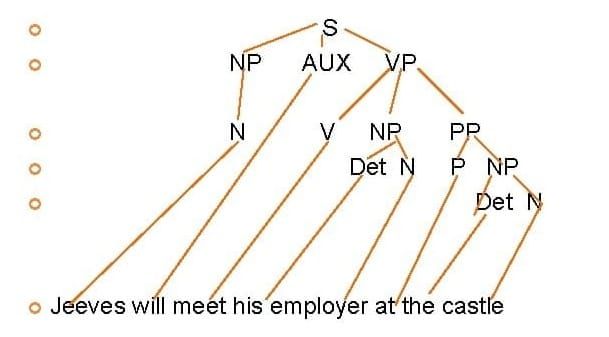
There is a relationship between ACP and Government & Binding (GB) theory in linguistics, but it’s easy to miss because it’s not a surface analogy. The connection lives at the level of constraint-based generativity, not at the level of subject matter.
GB is useful here precisely because it is not a theory of meaning. It is a theory of what cannot happen, where authority flows, and how movement is licensed or blocked. ACP converges on the same logic, but at the level of institutions rather than sentences.
1. What Government & Binding actually did (stripped of linguistics)
In its mature form (Chomsky 1980s), Government & Binding made three moves that matter here:
- It replaced construction-by-construction explanation with universal constraints.
- It treated grammaticality as a result of binding relations and locality, not surface plausibility.
- It made ungrammaticality as important as grammaticality.
Crucially, GB does not ask:
“What does this sentence mean?”
It asks:
“Is this derivation licensed under the system of constraints?”
That shift—from meaning to licensing—is the bridge to ACP.
2. Government ≈ Authority; Binding ≈ Legitimate Reference
In GB terms:
- Government is about which heads can license which constituents.
- Binding is about whether references (pronouns, anaphors) are legitimately anchored within a domain.
A sentence can be intelligible and still be ungrammatical if:
- a pronoun has no legitimate antecedent,
- movement crosses a forbidden boundary,
- authority is exercised outside its domain.
This is the key parallel:
ACP treats decisions the way GB treats pronouns:
a decision must be properly bound to an authorized agent within the correct domain.
An action without ownership in ACP is exactly like a pronoun without an antecedent in syntax. It may “parse” informally, but it is structurally illicit.
3. Locality constraints and ACP’s refusal logic
GB is obsessed with locality:
- bounding nodes,
- islands,
- minimal domains.
Why?
Because without locality constraints, anything could move anywhere, and the system would collapse.
ACP enforces the same principle institutionally.
ACP refusals often boil down to:
- authority crossing domains it does not govern,
- decisions “moving” from models to outcomes without passing through authorized roles,
- justifications skipping required intermediate structures.
This is not metaphorical.
In ACP terms:
- a model output “moving” directly into policy is a long-distance dependency violation,
- emergency logic that bypasses review is an island violation,
- “the system decided” is an unbound trace.
ACP exists to say: this derivation is not licensed.
4. Why GB is a better analogy than semantics or pragmatics
Most people reach for:
- semantics (“meaning”),
- pragmatics (“use in context”),
- discourse theory (“conversation”).
Those are weaker analogies.
GB is stronger because:
- it is non-interpretive at core,
- it tolerates nonsense sentences that are well-formed,
- and it rejects meaningful sentences that violate constraints.
ACP does the same.
ACP will:
- block a well-intentioned, high-performing system if authority is misbound,
- allow a tentative, incomplete process to proceed if binding and locality are intact.
This is why ACP feels “formal” even when it is ethical or political.
It is enforcing well-formedness conditions, not values.
5. Why this matters for AI specifically
Large language models are, in a literal sense, post-GB systems.
They generate fluent surface forms without explicit constraint checking.
That is exactly why ACP becomes necessary.
AI systems can produce:
- syntactically fluent outputs,
- epistemically plausible claims,
- socially acceptable recommendations,
while completely violating:
- authority locality,
- binding between claim and owner,
- legitimate derivation paths.
ACP reintroduces something GB-like at the institutional level:
a licensing layer that does not care how good it sounds.
6. The deeper shared instinct
Both GB and ACP share a deep design instinct:
You do not keep systems coherent by explaining everything.
You keep them coherent by forbidding the wrong derivations.
GB forbids illicit movement; ACP forbids illicit authorization. Neither promises truth, but both promise structural integrity.
7. Where the analogy stops (important)
ACP is not GB transplanted into politics.
- GB assumes an innate grammar; ACP assumes none.
- GB is universalist; ACP is explicitly institutional and historical.
- GB aims to explain competence; ACP aims to prevent collapse.
So this is not influence in the historical sense. It is convergence under similar constraints. When systems scale, generate freely, and act consequentially, constraint-based governance becomes unavoidable.
8. Restating the relationship
ACP relates to institutions the way Government & Binding relates to syntax: it enforces locality, binding, and licensing constraints so that fluent outputs do not become structurally illegitimate actions.
Member discussion: